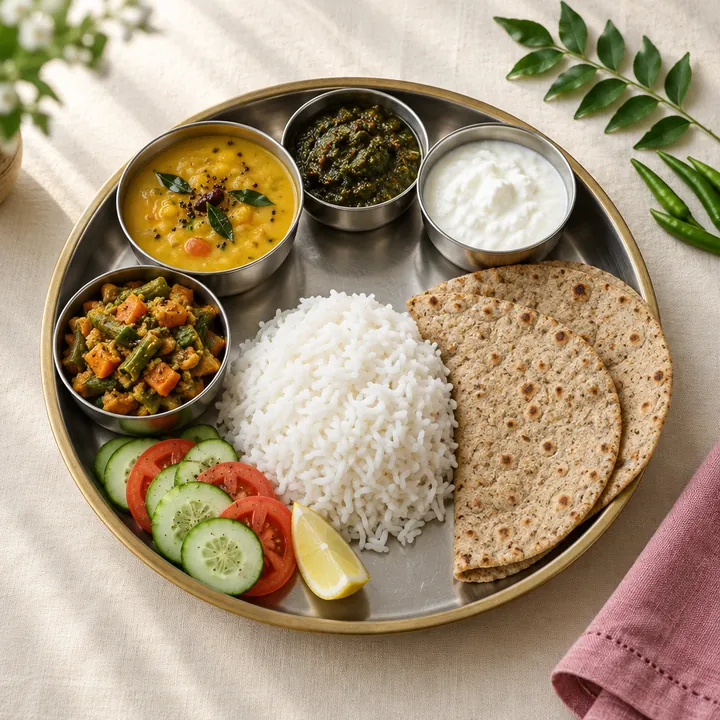
Pappu and annam — dal and rice — is the most ordinary lunch in a Hyderabad home. It’s also one of the cleverest. On their own, each is a little incomplete. Together, they cover each other’s gaps.
What ‘complete protein’ actually means
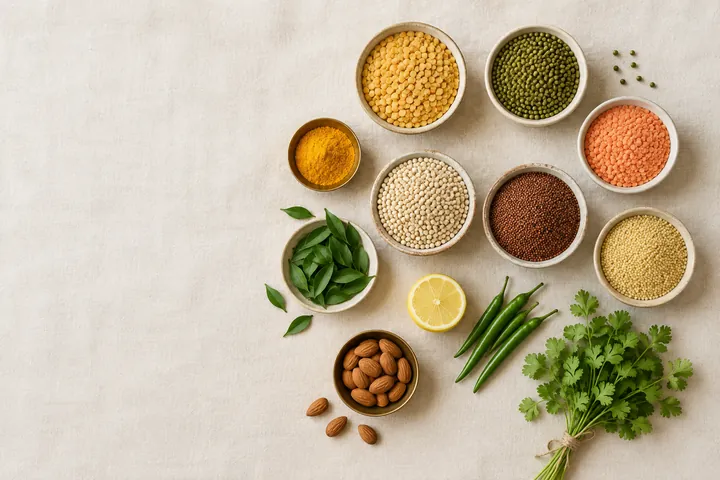
Proteins are built from amino acids, and nine of them have to come from food. Pulses are generous with lysine but run short of methionine; cereals like rice are the opposite. Eaten together — in the same meal or across the day — they give your body the full set.
Understand what your everyday food already does — then nudge it. Don’t replace it.
Two small additions that do even more
- A katori of perugu (curd) alongside adds more protein, plus live cultures for your gut.
- A squeeze of lemon over the pappu: vitamin C helps your body absorb the iron in pulses.
- A spoon of ghee in the tadka is welcome — it carries flavour and fat-soluble vitamins.
This is the pattern behind most of our advice: understand what your everyday food already does, then nudge it gently.
Sources
- ICMR–National Institute of Nutrition. Dietary Guidelines for Indians, 2024.
- National Institute of Nutrition, Hyderabad. Indian Food Composition Tables (Longvah T. et al.), 2017.